

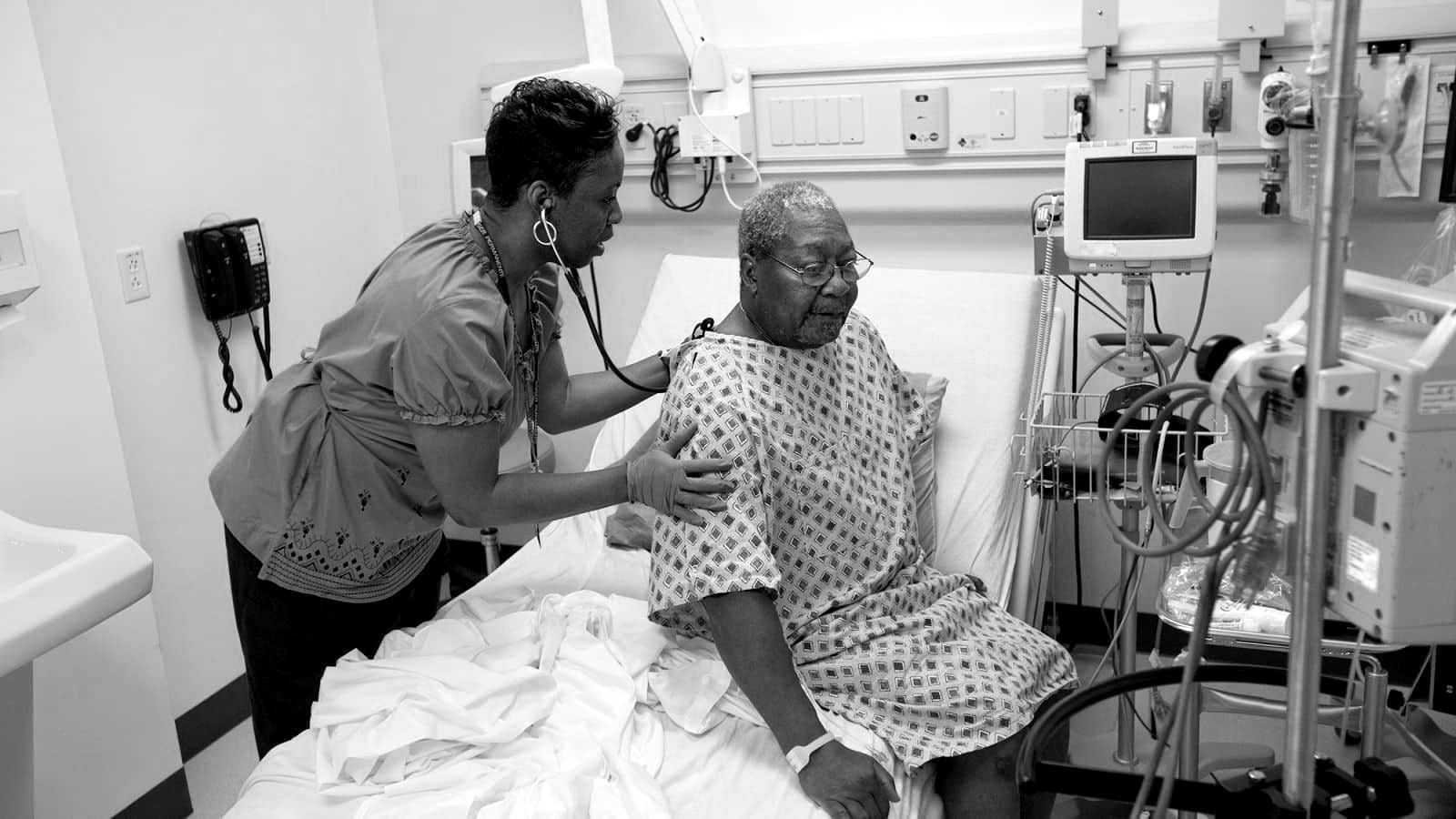
Before a doctor sees you, before a bed is assigned, before anyone runs a single test, somebody at a desk gives you a number between 1 and 5.
You will probably never be told what it is. It is not on your discharge paperwork. Most patients do not know it exists. But that number decides how long you sit, which part of the department you get moved to, and this is the part that matters how seriously everyone who touches you afterward treats what you came in saying.
Three peer-reviewed studies, using three different methods across three different data sets, all point the same direction: Black patients get worse numbers than white patients presenting the same way.
What the number actually is
The tool is called the Emergency Severity Index. It was built in 1998 by a group of emergency physicians and emergency nurses, and it is now maintained by the Emergency Nurses Association. As of 2019, roughly 94 percent of U.S. emergency departments use it.
The logic is straightforward. Level 1 means you need a life-saving intervention right now. Level 2 means high risk, and you should not wait. Levels 3 through 5 are sorted largely by how many "resources" the triage nurse predicts you will need — imaging, labs, IV medication, sutures. Oral medication and a prescription do not count as resources. A CT scan does.
So the score is not purely a measure of how sick you are. It is partly a prediction about how much the hospital is about to spend on you. And that prediction gets made in a short encounter at a desk, by one person, working off what you said, how you said it, and how you looked when you said it.
That is the mechanism. Now the findings.
Finding one: the acuity gap, measured directly
In 2013, Chad Schrader and Lawrence Lewis published a retrospective matched-cohort analysis in the Journal of Emergency Medicine. They pulled emergency department records and matched patients on age, gender, insurance status, time of arrival, co-morbidities, and abnormal vital signs then compared triage scores.
Black patients had a mean triage acuity score of 2.97. White patients had 2.81. A difference of 0.18, statistically significant at p < 0.001. On the ESI scale, a higher number means less urgent.
The same matched patients waited 10.9 minutes longer to reach a treatment area.
The authors' own conclusion was that the findings support the hypothesis that racial bias may influence the triage process after adjusting for the clinical variables that are supposed to explain the difference away.
Finding two: the gap widens when the complaint is subjective
In 2023, a team publishing in the Western Journal of Emergency Medicine went after the more specific question: does it matter what you come in complaining of?
They analyzed 297,355 adult emergency department visits at an urban academic hospital between 2016 and 2019, looking at whether patients were routed to the high-acuity side of the department. For complaints that can be objectively confirmed on arrival, the gaps were smaller. For subjective complaints the ones where the nurse has to take your word for it they were not.
Read that plainly: a Black patient walking into an emergency department saying "my chest hurts" had about 24 percent lower odds of being sent to the high-acuity side than a white patient saying the same thing. For shortness of breath, about 21 percent lower.
The finding that should stop you is the next one. When the researchers looked at patients who ultimately turned out to need high-acuity resources the ones who really were that sick Black and Hispanic adults were still disproportionately the ones who had been triaged low. The authors concluded the pattern cannot be explained by true differences in what those patients needed.
They were sick. The system just did not believe it at the door.
Finding three: results when stigma stacks
In 2025, Goldfarb and colleagues published an analysis in PLOS ONE using the National Hospital Ambulatory Medical Care Survey federal data, nationally drawn covering 2016 through 2020. They narrowed to 788 emergency department visits for substance use.
Black patients presenting with a substance use disorder had 53 percent lower odds of being assigned an immediate or emergent triage level than white patients presenting the same way. Odds ratio 0.47, p = 0.025. Hispanic patients showed no statistically significant difference in this data.
The authors named it directly: potential dual stigma, being Black and having a substance use disorder. Two judgments arriving at the same desk at the same time, compounding.
That sample is small 788 visits and MB will not pretend otherwise. But it is nationally drawn, and it is pointed in the same direction as the other two.
What the evidence does not say
MB does not run one-sided evidence, so here is the other side of the ledger.
A 2025 mixed-methods systematic review in PLOS ONE examined how patient race affects clinical interactions in U.S. emergency departments communication, interpersonal treatment, patient-reported experience. It found the evidence inconclusive. It included only nine studies. Two of those studies actually found Black patients reporting more positive emergency department experiences than white patients; another found Black patients reporting lower trust in clinicians. One found Black patients were more likely to be physically restrained, at a risk ratio of 1.22.
That review was not measuring triage acuity, which is the specific thing this piece is about. But it is a real caution, and it is worth saying out loud: the literature on race in the emergency department is uneven, the studies are often single-site, and researchers disagree about what the patient-experience data means.
What is not in dispute across these three triage-specific papers is the direction. Different decades, different methods, different populations 2013 matched cohort, 2023 single-site with nearly 300,000 visits, 2025 national survey data. All three found Black patients scored less urgent. None found the reverse.
Why the number follows you
Here is what fifteen years in healthcare operations taught me that the studies do not say out loud.
The triage score does not stay at the triage desk. It travels. It determines which pod or zone you are placed in, which changes the nurse-to-patient ratio you get. It shapes how quickly a physician picks up your chart. It is visible on the tracking board to every person who walks past it. And once a patient has been marked as a 3 rather than a 2, everyone downstream inherits that judgment as a starting assumption rather than a question.
That is why a 0.18 difference in a mean score is not a rounding error. It is a difference in the premise every subsequent clinician begins from.
And it is why the ten-minute wait gap matters more than ten minutes sounds like. For a heart attack, ten minutes is muscle. For a stroke, ten minutes is brain. For a person in withdrawal, in a psychiatric crisis, or in pain nobody is measuring, ten minutes is the difference between being treated and giving up and going home.
What would actually fix it
Not sensitivity training. There is no evidence a single training module changes a scoring decision made at speed under load.
What changes it is measurement. Emergency departments already capture every data point required to audit this: triage level assigned, chief complaint, race, arrival time, time to bed, resources ultimately used, and disposition. The audit is not technically hard. It is a query.
The question is whether hospitals run it, and whether anyone outside the building ever sees the result. Right now, at almost every hospital in this country, the answer to the second question is no.
That is the accountability gap MB is going after: not whether bias exists in triage three studies say it does but why a metric this measurable is this invisible.
Sources
- Schrader CD, Lewis LM. "Racial disparity in Emergency Department triage." Journal of Emergency Medicine. 2013;44(2):511–518. doi:10.1016/j.jemermed.2012.05.010
- Peitzman C, Carreras Tartak JA, Samuels-Kalow M, Raja A, Macias-Konstantopoulos WL. "Racial Differences in Triage for Emergency Department Patients with Subjective Chief Complaints." Western Journal of Emergency Medicine. 2023;24(5):888–893. PMC10527826
- Goldfarb S, Dix N, Spitz A, Graves K, Hansen MD, Hogans-Mathews S, et al. "Racial/Ethnic differences in emergency department triage assignment among visits for substance use." PLOS ONE. 2025;20(8):e0329376. doi:10.1371/journal.pone.0329376
- Flynn TJ, Jennings BM, Wright DW, et al. "Effects of patient race on processes and experiences of clinical interactions in US emergency departments: A mixed-methods systematic review." PLOS ONE. 2025;20(6):e0325315. doi:10.1371/journal.pone.0325315
- Emergency Nurses Association — Emergency Severity Index, stewardship and handbook (5th edition). ena.org/education/triage
- Agency for Healthcare Research and Quality — "Emergency Severity Index (ESI): A Triage Tool for Emergency Departments." ahrq.gov